
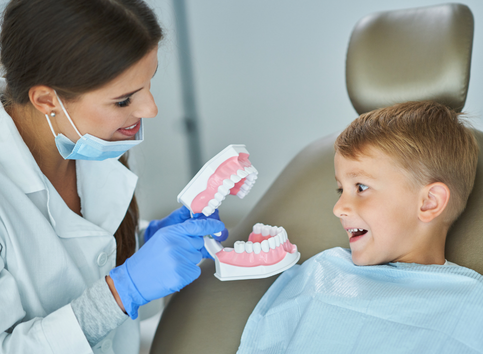
Cleaning a baby’s gums starts in the first weeks after birth, months before the first tooth breaks through. The routine takes less than a minute, needs no toothpaste, and builds the habit that brushing will later replace. Here’s what to expect.
The reason gums need cleaning before any tooth shows
Milk, formula and saliva leave a thin film on the gums after every feed. Bacteria in the mouth feed on the sugars in that film. Without teeth, the film cannot cause cavities, but it lets bacteria build up in the mouth, and those bacteria are ready to act on the first tooth as soon as it erupts. The first baby teeth usually appear between 6 and 10 months, and their enamel is thinner than adult enamel. Wiping the gums keeps the bacterial load low before that point. It also gets the baby used to having the mouth handled, which makes brushing easier later.
The supplies a newborn gum routine needs
A clean, soft washcloth or a square of sterile gauze is enough. Some parents prefer a silicone finger brush, which works the same way and is easier to control on a baby who moves. Lukewarm tap water is the only liquid needed. Toothpaste is not used before the first tooth appears. Wash your hands before each session, use a fresh cloth or gauze every day, and let a finger brush dry in open air between uses.
Wiping gums after feeds and before sleep
Hold the baby with the head supported, in your lap or on a changing table. Wrap the damp cloth around your index finger and wipe the upper and lower gums with light pressure, from front to back, then the inside of the cheeks. The tongue can be wiped too, since a white milk coating often collects there. Twice a day is the target: once after a daytime feed and once after the last feed before bed. The evening wipe matters most, because saliva flow drops during sleep and whatever stays on the gums sits there for hours.
Milk left on the gums during night feeds
Night feeds are normal in the first months and do not need to stop for oral health reasons. The issue is milk that pools in the mouth while the baby falls asleep. A baby who sleeps with a bottle in the mouth keeps milk against the gums, and later against the teeth, for long periods. Pediatric guidelines advise against putting a baby to bed with a bottle of milk, formula or juice. If the baby falls asleep during a feed, a quick wipe of the gums before laying the baby down removes most of the residue. Once teeth come in, this wipe becomes more important.
The switch from a cloth to a first toothbrush
The first tooth changes the routine. From that day, the cloth is replaced by a soft infant toothbrush with a small head, used twice a day. Current guidance from the American Academy of Pediatrics and the American Dental Association is a smear of fluoride toothpaste no bigger than a grain of rice for children under 3. Brush the front and back of each tooth and keep wiping the gums where teeth have not yet come in. The lower front teeth usually arrive first, followed by the upper front teeth a few weeks or months later. This is also the stage when many families start comparing practices, and one detail that separates the best pediatric dentist options for a baby is whether the team shows parents the brushing position and toothpaste amount at the first appointment.
Gum changes worth showing a pediatric dentist
Most of what parents notice on newborn gums is harmless. Small white or yellow bumps on the gums or the roof of the mouth, known as Epstein pearls and Bohn’s nodules, are common in newborns and disappear on their own within weeks. A white coating that wipes off easily is usually milk. A white patch that does not wipe off, or that bleeds when wiped, can be oral thrush and needs a visit to the pediatrician. A tooth present at birth, a bluish swelling over the spot where a tooth is about to erupt, or gums that stay red and swollen should be checked by a pediatric dentist. The recommended timing for a child’s first dental visit is by the first birthday or within six months of the first tooth, whichever comes first.
 Founder & Chief Visionary Officer
Xyphos Velmyre writes the kind of nurturing tactics and routines content that people actually send to each other. Not because it's flashy or controversial, but because it's the sort of thing where you read it and immediately think of three people who need to see it. Xyphos has a talent for identifying the questions that a lot of people have but haven't quite figured out how to articulate yet — and then answering them properly.
They covers a lot of ground: Nurturing Tactics and Routines, Daily Parenthood Highlights, Scoop Family Bonding Moments, and plenty of adjacent territory that doesn't always get treated with the same seriousness. The consistency across all of it is a certain kind of respect for the reader. Xyphos doesn't assume people are stupid, and they doesn't assume they know everything either. They writes for someone who is genuinely trying to figure something out — because that's usually who's actually reading. That assumption shapes everything from how they structures an explanation to how much background they includes before getting to the point.
Beyond the practical stuff, there's something in Xyphos's writing that reflects a real investment in the subject — not performed enthusiasm, but the kind of sustained interest that produces insight over time. They has been paying attention to nurturing tactics and routines long enough that they notices things a more casual observer would miss. That depth shows up in the work in ways that are hard to fake.
Founder & Chief Visionary Officer
Xyphos Velmyre writes the kind of nurturing tactics and routines content that people actually send to each other. Not because it's flashy or controversial, but because it's the sort of thing where you read it and immediately think of three people who need to see it. Xyphos has a talent for identifying the questions that a lot of people have but haven't quite figured out how to articulate yet — and then answering them properly.
They covers a lot of ground: Nurturing Tactics and Routines, Daily Parenthood Highlights, Scoop Family Bonding Moments, and plenty of adjacent territory that doesn't always get treated with the same seriousness. The consistency across all of it is a certain kind of respect for the reader. Xyphos doesn't assume people are stupid, and they doesn't assume they know everything either. They writes for someone who is genuinely trying to figure something out — because that's usually who's actually reading. That assumption shapes everything from how they structures an explanation to how much background they includes before getting to the point.
Beyond the practical stuff, there's something in Xyphos's writing that reflects a real investment in the subject — not performed enthusiasm, but the kind of sustained interest that produces insight over time. They has been paying attention to nurturing tactics and routines long enough that they notices things a more casual observer would miss. That depth shows up in the work in ways that are hard to fake.