
Even in loving homes, many parents quietly wonder why they feel disconnected from their child despite sharing the same space every day. As children grow, the communication gap can widen, leaving conversations stuck at surface-level check-ins instead of meaningful exchanges. This article addresses that challenge head-on, offering practical ways to strengthen parent child communication habits and turn everyday moments into opportunities for deeper understanding. You’ll discover actionable, age-appropriate strategies designed to build trust, encourage openness, and create lasting connection—helping your family bond grow stronger from the inside out.
The Foundation: Creating a Safe Harbor for Open Hearts
Psychological safety is the bedrock of healthy communication. In simple terms, it means a child feels safe to speak without fear of ridicule, punishment, or dramatic overreaction. When that safety exists, honesty grows. When it doesn’t, silence moves in (and silence is much harder to decode).
Some argue that too much emotional openness makes children “soft.” Research disagrees. Studies on child development consistently link emotionally responsive parenting to stronger self-regulation and resilience later in life (American Psychological Association).
One core feature of strong parent child communication habits is Active Listening. This goes beyond hearing words. It includes:
- Paraphrasing: “So, you felt frustrated when your friend ignored you?”
- Clarifying: “What happened right before that?”
- Reflecting tone: Matching calm energy to lower emotional intensity.
Another essential detail is validating feelings, not behavior. Saying, “It’s okay to feel angry” acknowledges emotion. Adding, “but it’s not okay to hit” sets a clear behavioral boundary. Both can coexist.
Finally, offer undivided attention. Put the phone away. Turn off the TV. Make eye contact. These small, observable actions signal priority. (Yes, they notice when you’re half-scrolling.)
Pro tip: Schedule 10 distraction-free minutes daily. Consistency builds trust faster than occasional grand gestures.
Connecting with Little Ones: Speaking the Language of Play and Patience

Communicating with young children is less like delivering a speech and more like tuning into a tiny, ever-changing radio frequency. If you don’t adjust the dial, you’ll miss the message. Strong parent child communication habits begin with meeting kids where they are—literally and emotionally.
Get on Their Level
When you kneel to a child’s eye level, you shrink what can feel like a towering authority figure into a safe harbor. For toddlers especially, physical posture signals emotional safety. Research in early childhood development shows children are more responsive when adults use warm, face-to-face engagement (Harvard Center on the Developing Child). Think of it as switching from broadcasting to connecting.
Use “I Wonder…” Statements
“I wonder what was going through your mind when you drew on the wall” works like opening a window instead of slamming a door. Direct “why” questions can spark defensiveness because young brains are still developing reasoning skills. Curiosity invites conversation. It turns conflict into a shared puzzle rather than a courtroom scene (and nobody likes feeling cross-examined).
Leverage Playtime
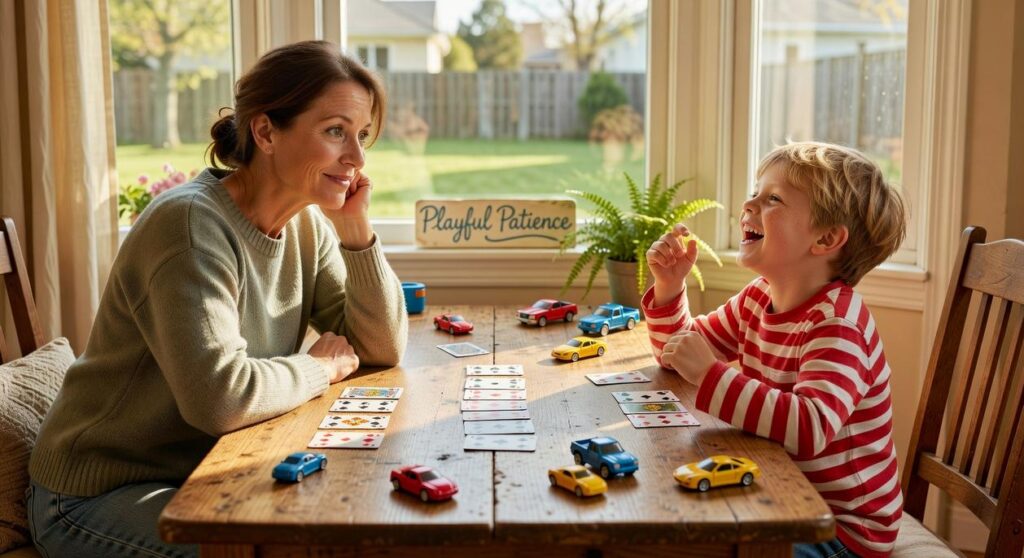
Play is a child’s native language. Dolls, blocks, and crayons become emotional translators. When you narrate—“Your teddy looks sad”—you help them build vocabulary for feelings. The American Academy of Pediatrics notes that play strengthens emotional regulation and resilience.
Keep It Short and Simple
Young minds process information like small cups catching rain—too much, and it spills. Use clear phrases and pause. LET SILENCE WORK.
For deeper support, explore creating calm spaces at home for emotional regulation. Pro tip: consistency beats perfection every time.
The teenage years can feel like living with a brilliant roommate who suddenly locks their door. Adolescents are wired to pull away; psychologists call this individuation, the process of forming a separate identity. Some argue you should push harder, set stricter rules, and demand answers. Structure matters, yes. But forcing connection often backfires (think less “Family Meeting,” more FBI interrogation).
Start with the side-by-side talk. Conversations flow more naturally in the car, while folding laundry, or walking the dog because eye contact is indirect and pressure drops. Research in developmental psychology shows teens disclose more when they feel less scrutinized (Steinberg, 2014). So drive them to practice and let silence do some work.
Next, upgrade your questions. “How was school?” invites a shrug. Instead try, “What was the most interesting or ridiculous thing that happened today?” Open-ended questions signal genuine curiosity and strengthen parent child communication habits over time. If they answer with one word, resist the urge to lecture; follow up gently.
Equally important, respect timing. Teens often open up at inconvenient moments—right before bed or five minutes before you log into a meeting. If you can, pause and listen. If you truly cannot, schedule a specific later time and keep it.
Finally, share a brief, appropriate story about your own awkward years. Not a monologue—just enough to say, “I get it.” Vulnerability builds trust, and trust keeps the door unlocked. Over time, these small shifts create safer space for honesty, resilience, and deeper connection. Consistency makes the difference.
Conflict is inevitable, but disconnection doesn’t have to be. When tension rises, shift from “me vs. you” to “us vs. the problem.” That small reframe turns blame into teamwork.
Consider two approaches. In A, you snap, “You’re always late!” In B, you try the feeling sandwich: “I appreciate how hard you try, but I feel anxious when curfew is missed. How can we fix this?” Same issue, different outcome.
Of course, some argue tough love works faster. Yet research shows collaborative dialogue builds healthier parent child communication habits long-term.
And if emotions spike, pause. Agree to cool down and revisit
Your Journey to a Deeper Bond Starts Today
Building stronger parent child communication habits isn’t a one-time fix — it’s an ongoing practice. There will be awkward moments and small missteps, but progress matters more than perfection. If you’ve been carrying the quiet fear of growing distant from your child, know that intentional effort can close that gap.
These strategies work because they’re rooted in respect, empathy, and genuine curiosity about your child’s inner world. Connection grows where understanding lives.
Choose one strategy that resonates with you and try it tonight. The goal isn’t a perfect conversation, but a more connected one.
 Founder & Chief Visionary Officer
Xyphos Velmyre writes the kind of nurturing tactics and routines content that people actually send to each other. Not because it's flashy or controversial, but because it's the sort of thing where you read it and immediately think of three people who need to see it. Xyphos has a talent for identifying the questions that a lot of people have but haven't quite figured out how to articulate yet — and then answering them properly.
They covers a lot of ground: Nurturing Tactics and Routines, Daily Parenthood Highlights, Scoop Family Bonding Moments, and plenty of adjacent territory that doesn't always get treated with the same seriousness. The consistency across all of it is a certain kind of respect for the reader. Xyphos doesn't assume people are stupid, and they doesn't assume they know everything either. They writes for someone who is genuinely trying to figure something out — because that's usually who's actually reading. That assumption shapes everything from how they structures an explanation to how much background they includes before getting to the point.
Beyond the practical stuff, there's something in Xyphos's writing that reflects a real investment in the subject — not performed enthusiasm, but the kind of sustained interest that produces insight over time. They has been paying attention to nurturing tactics and routines long enough that they notices things a more casual observer would miss. That depth shows up in the work in ways that are hard to fake.
Founder & Chief Visionary Officer
Xyphos Velmyre writes the kind of nurturing tactics and routines content that people actually send to each other. Not because it's flashy or controversial, but because it's the sort of thing where you read it and immediately think of three people who need to see it. Xyphos has a talent for identifying the questions that a lot of people have but haven't quite figured out how to articulate yet — and then answering them properly.
They covers a lot of ground: Nurturing Tactics and Routines, Daily Parenthood Highlights, Scoop Family Bonding Moments, and plenty of adjacent territory that doesn't always get treated with the same seriousness. The consistency across all of it is a certain kind of respect for the reader. Xyphos doesn't assume people are stupid, and they doesn't assume they know everything either. They writes for someone who is genuinely trying to figure something out — because that's usually who's actually reading. That assumption shapes everything from how they structures an explanation to how much background they includes before getting to the point.
Beyond the practical stuff, there's something in Xyphos's writing that reflects a real investment in the subject — not performed enthusiasm, but the kind of sustained interest that produces insight over time. They has been paying attention to nurturing tactics and routines long enough that they notices things a more casual observer would miss. That depth shows up in the work in ways that are hard to fake.